Publishing an artifact
A figure in a paper can carry a URL. Someone who opens it (a referee, a replicator, you in eighteen months) sees the result, the code that produced it, and the code and environment of every step behind it. No account, no install, no notebook.
strata artifact publish nb_paper_cell_c2_var___display__0 --title "Figure 3" \
  --artifact-dir ./paper/.strata/artifacts
nb_paper_cell_c2_var___display__0@v=1 is public at /p/ocxQj-toxGttZYyRl-Zf9...
Published into ~/.strata/artifacts (the store your server serves).
Copied 2 artifacts across so the link resolves.

Anyone with that link can read the artifact, its source, and the
source and environment of every step behind it. That is the point,
and it is worth knowing before sending the link:
  - nb_paper_cell_c2_var___display__0@v=1
  - nb_paper_cell_c1_var_rows@v=1

Withdraw it with: strata artifact unpublish ocxQj-toxGttZYyRl-Zf9...
The link starts with the server's STRATA_PUBLIC_BASE_URL and
STRATA_PUBLIC_BASE_PATH when they are set, or with --to-url when publishing
to another store.
Every cell output is already an artifact, and a plot is no exception: it is stored under its own id with a provenance hash binding it to its inputs, its source, and the environment it ran in. Publishing does not create any of that. It grants read access to one version of it.
Where the artifact ends up
A notebook writes its cell outputs to its own .strata/artifacts; the server
serves whatever artifact_dir it was started with, ~/.strata/artifacts by
default. Publishing therefore copies the artifact, and every step behind it
since the page shows their code, into the store the server serves, and mints
the token there. Point --artifact-dir at the notebook's .strata/artifacts,
as above; without it the command reads the server's store, which does not hold
the notebook's outputs until something copies them there. The command says how
many it moved:
The copies keep their original ids, versions, provenance hashes, authors and timestamps. An artifact that moves into a served store has to keep saying who computed it and when; publishing is not a re-computation and must not read like one.
Reading and publishing are separate arguments, because they are separate questions:
| Argument | Means |
|---|---|
--artifact-dir |
the store to read the artifact from, as in every other subcommand |
--into DIR |
the store to publish into |
--to URL |
a Strata server to publish to over HTTP (see below) |
--here |
publish into the store named by --artifact-dir |
--into defaults to the store your server serves, which is what makes a link
resolve. Whichever applies, the destination is printed:
Published into ~/.strata/artifacts (the store your server serves).
Copied 4 artifacts across so the link resolves.
--header 'Name: value' (repeatable) adds a header for --to beyond the
STRATA_STORE_TOKEN bearer, and --max-depth (default 10) bounds how far the
chain is listed.
That line is not conditional. A caller who is never told where a grant lives cannot tell a working link from one their own server will never resolve, and the silent case used to be exactly the one where it already matched.
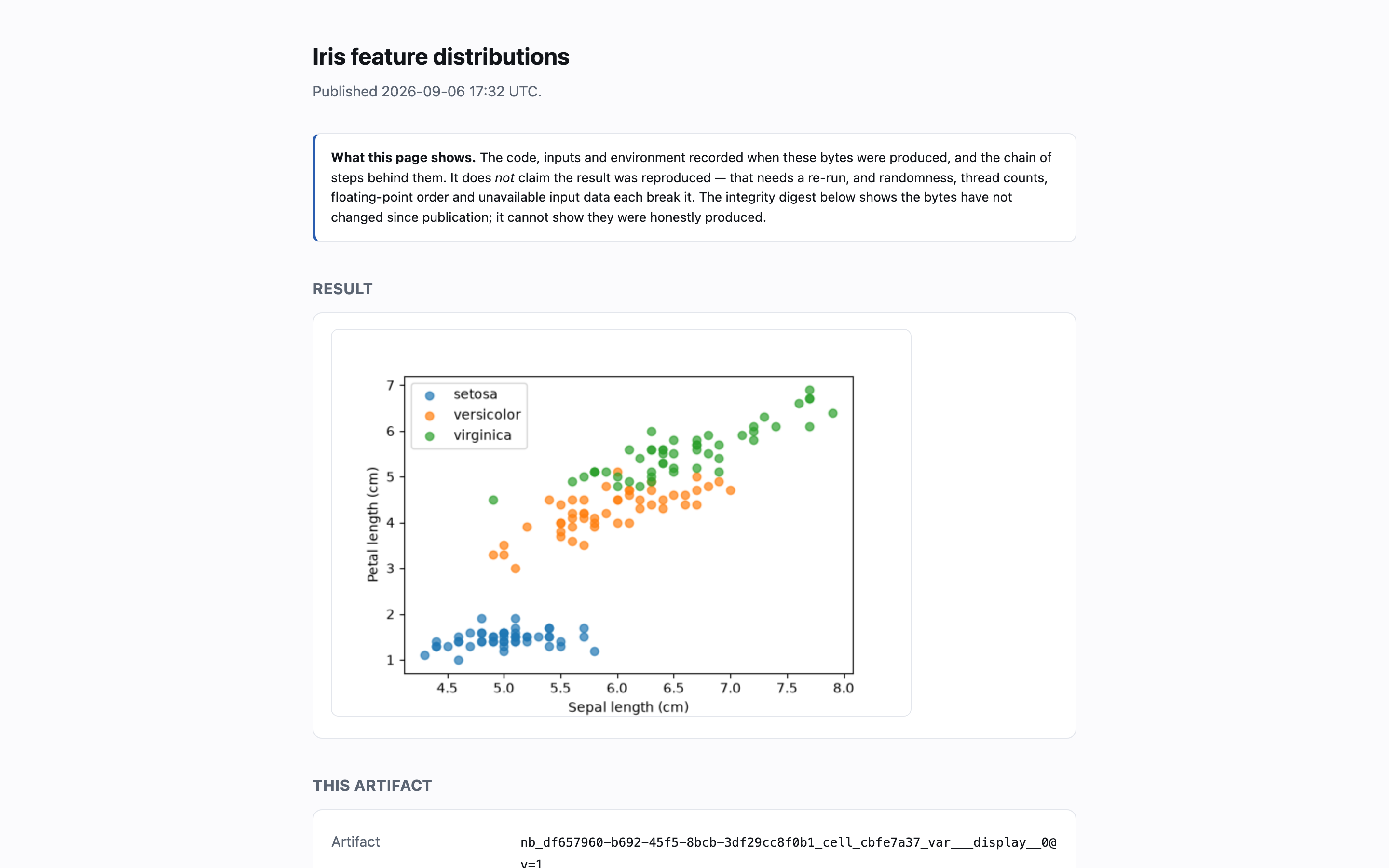
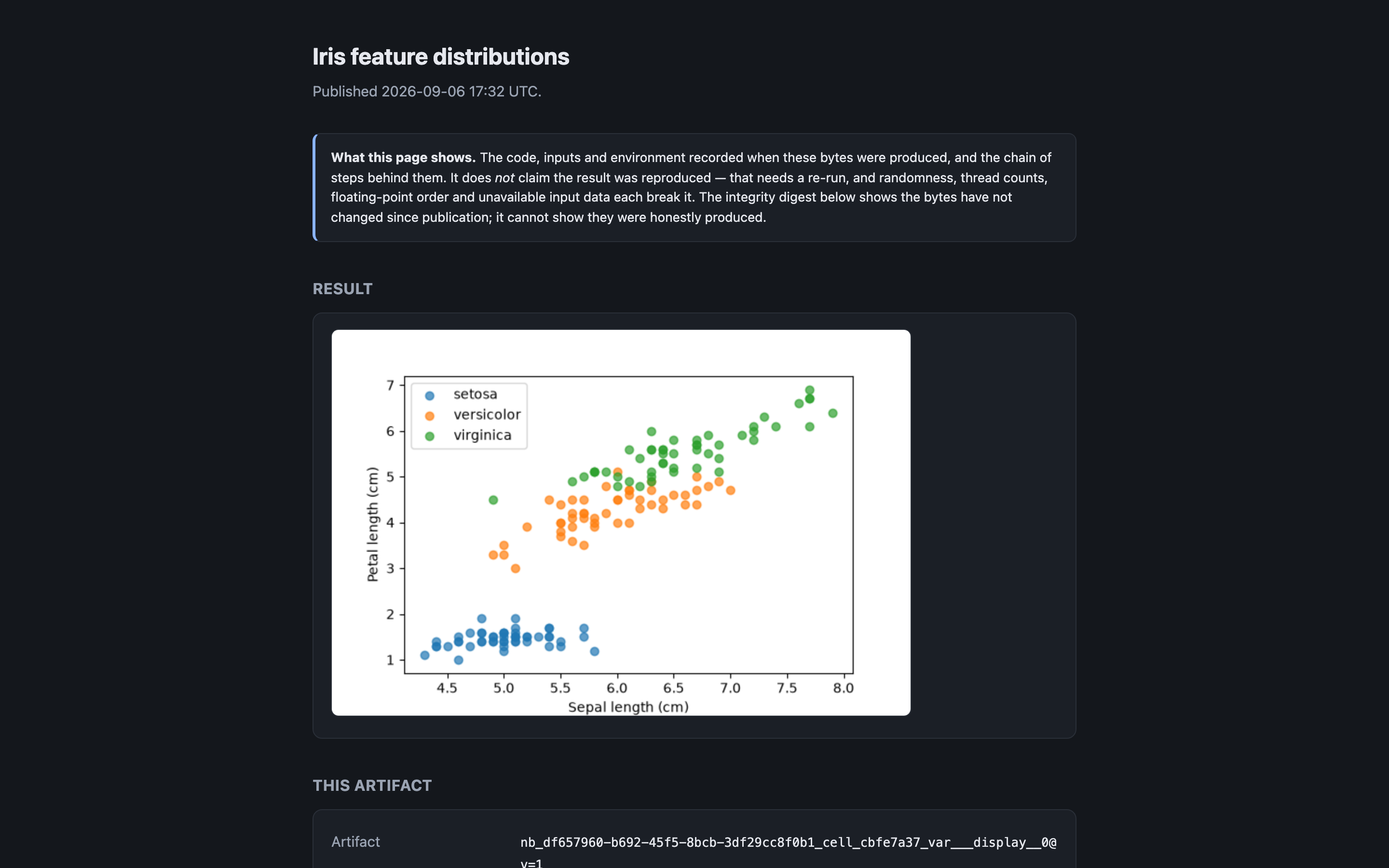
What the page claims, and what it does not
This matters more here than in most features, because the reader is being asked to trust what they see.
Transparency. The page shows the code, the inputs, the environment and the author as recorded when the bytes were produced, not as they look now. A cell edited after the run does not change what its artifact reports.
Integrity. A digest of the bytes is recorded at publication, and
/p/<token>/verify re-reads them and compares. That proves the bytes have not
changed since they were published. It does not prove they were honestly
produced in the first place: nothing a server can compute about its own
storage could establish that.
Reproduction is not claimed. Re-running the computation and getting the same result is the strongest thing anyone could want, and it is not something Strata asserts. Random seeds, thread counts, floating-point accumulation order and unavailable input data each break it on their own. So there is no green check anywhere on the page: in a research context a checkmark is read as "someone reproduced this", and a badge that can be wrong is worse than no badge. The page says what it checked, in words. Re-running is left to the reader; the source and environment shown are what it takes.
Publishing exposes the chain
This is the feature working as intended, and it is the thing to think about before sending a link. The page shows the source and environment of every upstream step, because a plot whose ancestry is hidden answers nothing.
Upstream cell source can name private dataset paths, internal table names, or credential names. So publishing is explicit, one artifact version at a time, never a switch on a whole notebook, and the CLI prints the full list of steps the link will expose before you use it.
Upstream data is never served. The page describes the steps; only the
published artifact's own bytes are downloadable, at /p/<token>/data.
Those bytes are served as data, never as a page. A PNG, Arrow, JSON or Markdown
artifact is served under its own type; any other declared type (HTML or SVG, for
instance, which a writer can set freely) downloads as
application/octet-stream. Every response carries
X-Content-Type-Options: nosniff and Content-Security-Policy: sandbox, so
nothing published runs script on your server's origin.
Withdrawing
<token> can also be the publication's id, which GET /v1/publications
lists. The store keeps only each token's SHA-256 (its id), so the token, and the
link built from it, is shown once: in the answer to the publish that minted it.
A version has at most one live publication. Publishing the same version again
returns the existing publication without a token; keep the link when it is minted, or unpublish and publish again for a new
one.
The link then reports that it was withdrawn, rather than 404ing. A reader chasing a footnote deserves that answer rather than one that reads like a typo. The token is never reissued for other content, so a URL already in print fails closed instead of quietly starting to resolve to something else.
A badge for a README
It reports the size of the recorded chain (provenance · 4 steps) and links
to the page. It says nothing about whether the result is right, and it is
deliberately not green: in badge convention green means "passing", and
borrowing that would smuggle back the claim the rest of this is careful to
avoid.
A withdrawn publication still renders a badge, reading withdrawn. A broken
image tells a reader nothing except that something is wrong with the server.
A badge is a pointer, not a revocation mechanism. GitHub proxies badge images through its own cache, so a withdrawal can take a while to show. The page and the bytes stop immediately; the pill in someone's README lags.
The page carries ready-made snippets for the badge, the iframe and the RO-Crate URL, under Putting it somewhere.
Machine-readable provenance
The chain is also published as RO-Crate JSON-LD, which repositories and provenance tooling read directly:
- inline on the page, in a
application/ld+jsonscript block; - at
/p/{token}/ro-crate, so a harvester need not scrape the page; - as
ro-crate-metadata.jsonin an archived bundle, which is what turns a Zenodo deposit from a folder someone can read into something the archive can index.
The graph maps each step to a CreateAction whose instrument is the cell
source as SoftwareSourceCode, its object the inputs and its result the
output: the shape PROV-O and RO-Crate both expect for "this code, on these
inputs, made this".
Upstream steps are CreativeWork entities, not files, and they are not
listed under hasPart. Their bytes are deliberately not in the crate, and
declaring files that are not there is a claim no validator would catch.
An input past the depth limit is still named, as a stub saying the recorded
chain stops there, so no reference dangles.
People appear once each. A step run by someone listed as an author points at that author's node (the ORCID when one is given, as a bare id or a link), and an author listed twice is credited once.
A step that read a URL through @fetch names it as
an input. On the page it appears under "External inputs" with the digest of the
bytes read, when they were retrieved, and when the reading step ran. In the
crate it is a File whose @id is the URL, with that sha256 and the
retrieval time as sdDatePublished. The digest describes what was read, and
the URL may serve something else now. A step stored before retrieval times were
recorded shows only when it ran.
A Snowflake or BigQuery cell with # @cache snapshot,
published or upstream of what is, shows the moment of the warehouse state it
read ("Warehouse state as of") and how long the warehouse keeps that state
("Queryable until"). Until then a reader with access to the warehouse can run
the query against the same state; after it, they cannot. A cell stored before
the horizon was recorded shows "not recorded".
Embedding it elsewhere
Paste the link into a wiki, CMS or note-taking tool that speaks oEmbed and it unfurls into a card: the figure, what it is, how many steps are behind it, and a link through to the full provenance. Tools that do not, take the iframe directly:
<iframe src="https://your-strata/p/<token>/embed"
        width="480" height="420" frameborder="0"></iframe>
The card is deliberately not a smaller copy of the page. An embed sits in a post where the surrounding text is doing the explaining, so it carries the result and an honest one-line summary, then links out. Abbreviating the caveats into a card would produce exactly the badge this feature avoids.
The card is framable from any origin, because being embeddable is the whole
point of it. That applies to /p/{token}/embed and nothing else: the full
page keeps the default frame-ancestors 'self', and embed_frame_ancestors
still governs the notebook app view.
Behind a reverse proxy, set STRATA_PUBLIC_BASE_URL to the address readers
use. The URLs in an embed are consumed by someone else's page, and a server
that only knows its internal origin will advertise an oEmbed endpoint nobody
can reach and reject the public link a wiki pastes. Unset, the request's own
origin is used, which is right for a directly-reachable server.
A proxy that serves Strata under a path also needs STRATA_PUBLIC_BASE_PATH
(Serving under a path); every
link on the page and in the card then carries it.
Archiving: the copy that needs no server
A hosted link resolves for as long as your server does. A URL printed in a paper outlives most servers, so there is a second form:
strata artifact archive nb_paper_cell_c2_var___display__0 \
  --artifact-dir ./paper/.strata/artifacts \
  --to ./figure3-bundle --title "Figure 3" --author "F. Li"
figure3-bundle/
├── index.html              the page: opens in a browser, no server, no external requests
├── artifact.png            the bytes
├── manifest.json           the same record, machine-readable
├── ro-crate-metadata.json  the chain as RO-Crate
└── README.md               what it is and how to check it
--force writes into a non-empty directory (which may leave a stale payload
beside the new one); --max-depth (default 10) bounds how far the chain is
walked. With --token it defaults to 25, the depth the hosted page and its
archive walk.
A tabular artifact's bytes are Arrow IPC (artifact.arrow), and the bundle
also carries artifact.parquet, the same rows in a format a data repository
indexes. The manifest's digest covers the Arrow file; the Parquet file carries
its own, in the manifest's additional_files and as a second File in the
RO-Crate, so a repository reading the crate sees both. A table whose Arrow file
is over 128 MiB is archived without the Parquet copy, since converting it holds
the whole table in memory; neither the manifest nor the crate then lists one.
The limit is fixed, so it never makes one publication's archive differ between
builds.
Whichever file a reader kept, the server can say whether it is this
publication's. GET /p/<token>/verify?sha256=<digest of the file> answers with
file naming it (artifact.arrow or artifact.parquet, or null for a file
from elsewhere) and matches true only when it names one and the stored bytes
are unchanged. The Parquet digest is the one in the archive the server serves.
Deposit the directory with Zenodo or OSF and cite the DOI. The archive's retention promise then stands behind the link instead of yours.
A published artifact serves the same bundle as a zip:
Same files, same code: the route and the command build the bundle from one
implementation, because two implementations of a set of files that describe
each other would drift and neither would stop producing a bundle. The response
carries a Content-Digest of the zip, and the zip is the same bytes on every
request, so a digest you record at deposit time can be checked against a later
fetch. The server builds it once and keeps it under publication-archives/ in
the artifact directory: later requests send that file, editing the
publication's authors or identifiers rebuilds it, and withdrawing deletes it.
To build that zip from the store directly, name the publication rather than the
artifact. The bundle then carries the publication's own record, with the
authors and identifiers the hosted page shows, and a --to ending in .zip
writes the file the route serves, byte for byte:
--token also takes the publication's id, which GET /v1/publications lists,
since the raw token is shown only when the link is minted.
A withdrawn publication refuses here as it does for the bytes: the page still resolves and says "withdrawn", since a reader chasing a footnote deserves that answer, but handing over the archive anyway would undo the withdrawal.
It needs no credentials, like the page, and contains nothing the page does not already show: the artifact's own bytes and the chain as rendered. Upstream bytes stay where they are.
The page is the same document as the hosted one, with one difference: it points at the file beside it rather than at routes, and it tells the reader how to check the bytes themselves:
Archiving is not publishing. It grants nobody access to a running server and mints no link. It writes files you choose who to hand to.
Crediting an author
The page carries two different facts, and they come from different places.
Who published or archived it is the byline under the title. --author sets
it on either command; in service mode a publish through the API uses the
authenticated principal instead. Omit it and there is simply no byline.
Who computed it is the Computed by row, and it comes from the artifact
itself, recorded when the cell ran, not when you published. On a server that
authenticates its callers (service mode) it is the member who ran the cell. A
personal server has no authenticated identity to record, so there the row
usually reads "not recorded".
--author does not change it: crediting yourself for publishing a result is
not the same as the store attesting who produced it, and the page keeps them
apart deliberately.
Who wrote the work is a third thing, and a list rather than a string: authors have an order, an affiliation, and an ORCID that distinguishes one researcher from another. Pass them when publishing over HTTP:
POST /v1/artifacts/nb_paper_cell_c2_var___display__0/v/1/publish
{
  "title": "Figure 3",
  "authors": [
    {"name": "F. Li", "orcid": "0000-0002-1825-0097", "affiliation": "Somewhere"},
    {"name": "B. Second"}
  ]
}
The byline then lists them in the order given, each ORCID as a link. Publishing
without authors leaves published_by as the byline, so nothing published
before this changes meaning.
Citing it: DOIs and other identifiers
A DOI is registered against a deposit that already has to be reachable, so it almost always arrives after the token does:
PATCH /v1/publications/{token}
{"external_ids": [{"scheme": "doi", "value": "10.5281/zenodo.1234567"}]}
Schemes are doi, zenodo, arxiv and url; anything else is refused, since
a record that accepted arbitrary scheme names would produce citation lines
nobody can follow. The page grows a "Cite as" line of resolvable links, the
JSON record and the archive manifest.json carry the entries, and the
RO-Crate's root dataset gets the DOI as its identifier, which is what an
ingesting repository indexes on.
The patch cannot repoint the token, because a citation whose target could
change under the reader would be worthless. A body naming artifact_id or
version is refused with a 400 rather than half-applied, so a caller never
reads a 200 as "the link now shows the other version". To cite another version,
publish it for its own link.
Each patch is recorded on the store's event feed (GET /v1/events) as a
credit event with the publication's id in value, beside publish and withdraw, so a
service mirroring the page learns of a new DOI without polling.
Copying a chain into another store
A link resolves from the store its server serves, and a chain lives in the
store its cells wrote to. When those are different machines, the chain is
imported into the serving store first, ancestors before descendants, keeping
each version's id and number so its lineage edges still resolve.
strata artifact publish --to <url> does this for you, and a service doing it
over HTTP does the same: upload each version's bytes, then its record:
PUT  /v1/artifacts/import/blobs/{content_sha256}     the bytes, checked against the digest; 201
POST /v1/artifacts/import                    {"id": ..., "version": ..., "provenance_hash": ...,
                                              "created_at": ..., "content_sha256": ...,
                                              "input_versions": ..., ...}
The record's content_sha256 names the bytes uploaded before it, and only the
same tenant's upload counts: a digest is printed on every publication's page,
so knowing one proves nothing. An upload nothing imports is dropped a day later.
The import stamps the caller's tenant on the row, answers 409 for an id another
tenant holds (at any version) or a version another computation holds unless
?remap=true is set, and is
idempotent: repeating a finished import writes nothing and needs no new upload.
The same route also takes a multipart body with the record as metadata and
the bytes as data. The server copies data to disk as it arrives, but a
client usually builds the whole body in memory, so large artifacts suit the
staged route.
publish --to streams each artifact's bytes from a file to the upload route
and sets remap. So a chain another tenant on the target already holds (or a
version id a different computation took there) lands as a copy under a fresh
id, <id>@import=<8 hex>, in the caller's tenant. Each copy keeps its
provenance hash, and the CLI points every descendant's lineage edges at the
ids its ancestors landed on, so the published page resolves every step.
Publishing the same chain again writes nothing. The target refuses a blob
larger than its STRATA_MAX_UPLOAD_BYTES with 413; raise it there to publish
larger artifacts.
HTTP
| Route | Auth | Purpose |
|---|---|---|
POST /v1/artifacts/{id}/v/{n}/publish |
yes (artifacts:publish) |
Mint a link. The response carries token and url, the only time they are shown, and id. Idempotent: republishing returns the existing publication, with token and url null. |
DELETE /v1/publications/{token} |
yes (artifacts:publish) |
Withdraw, by token or id. |
PATCH /v1/publications/{token} |
yes (artifacts:publish) |
Set authors and external identifiers, by token or id. Cannot change what the token points at: artifact_id or version in the body is a 400. |
GET /v1/publications |
yes | List this tenant's live publications by id, without tokens (?include_revoked=true adds withdrawn ones). |
PUT /v1/artifacts/import/blobs/{content_sha256} |
yes (artifacts:write) |
Upload a version's bytes ahead of its record. |
POST /v1/artifacts/import |
yes (artifacts:write) |
Import a version, keeping its id and number. |
GET /p/{token} |
no | The page. |
GET /p/{token}/data |
no | The published bytes. |
GET /p/{token}/archive.zip |
no | The archived bundle as a zip, with a Content-Digest header. |
GET /p/{token}/verify |
no | Re-read and compare against the recorded digest. ?sha256= also says which bundle file (Arrow or Parquet) a digest names. |
GET /p/{token}/embed |
no | The card, for an <iframe>. Framable from any origin. |
GET /oembed?url=… |
no | oEmbed provider, so a pasted link unfurls. |
GET /p/{token}/ro-crate |
no | The chain as RO-Crate JSON-LD. |
GET /p/{token}/badge.svg |
no | A README pill reporting the chain size. |
GET /v1/publications/{token} |
no | The same record as JSON. |
For a withdrawn token the page, the badge and GET /v1/publications/{token}
still answer and say so; the record then carries only the token, title and
the publish and withdraw times, no chain or source. Every route that serves
content (/data, /archive.zip, /verify, /embed, /ro-crate and
/oembed) answers 410 Gone.
The unauthenticated routes are exempt from the auth and tenant middleware by
path, and only for GET. The token is the credential: it exists only because
someone with authority over that artifact minted it for one version. Minting,
withdrawing, editing credits and listing all stay behind the gate.